
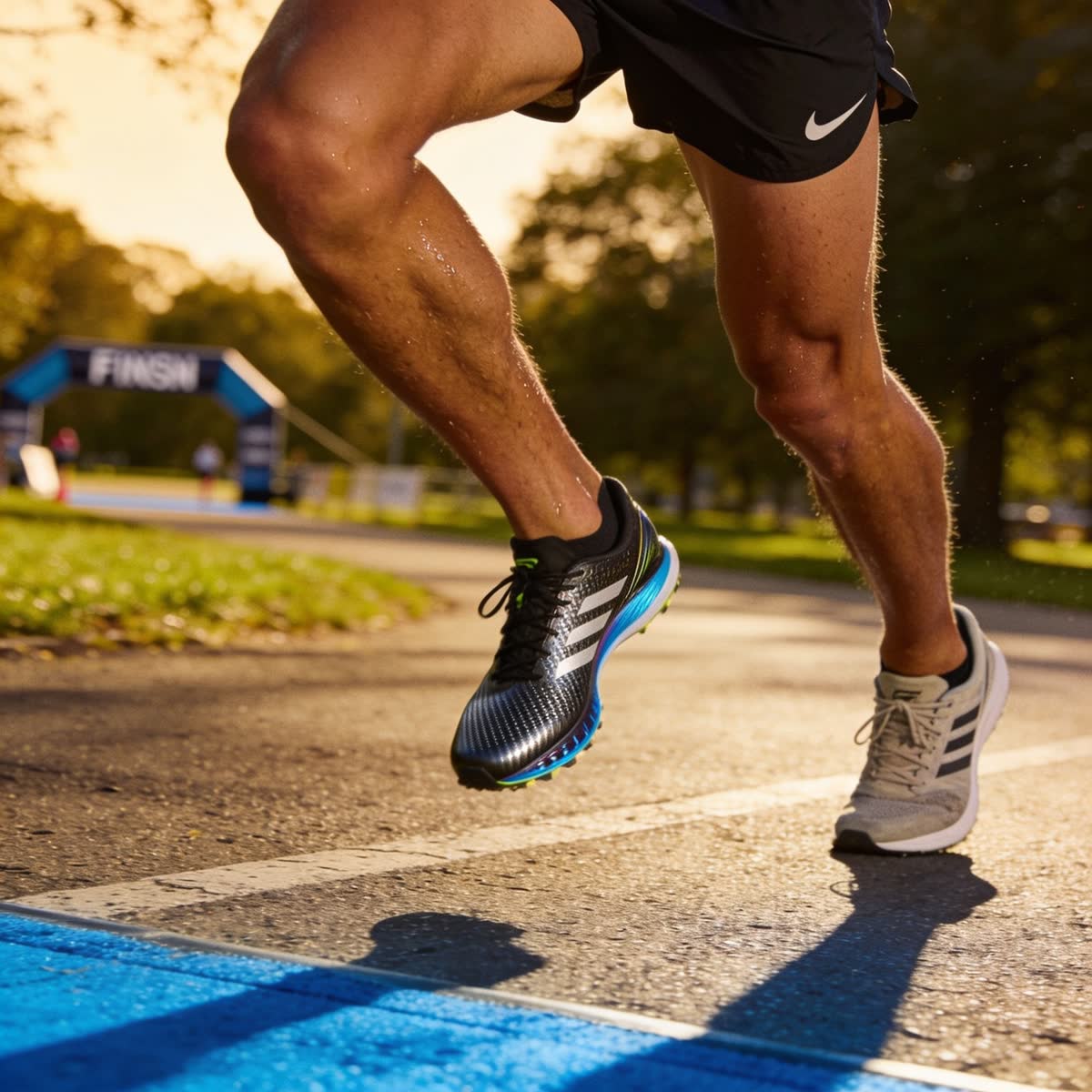
The Real Reason Carbon-Plated Shoes Won't Help Your First 5K (And What Actually Will)
You’ve signed up for your first 5K. Maybe it’s eight weeks out, maybe twelve. You want to do this right, so you start researching. Within ten minutes you’re down a rabbit hole of carbon-plated racing flats, gait analysis videos, and forum arguments about heel drop. A pair of Vaporflys goes into your cart. You hesitate at the price, then justify it: if you’re going to train seriously, you need serious shoes.
Here’s what nobody mentions in those reviews: for a brand-new runner, those expensive shoes will do almost nothing.
A recent analysis found that carbon-plated shoes improve performance by roughly 3%. That’s real - if you’re already running a 20-minute 5K, you might shave off 36 seconds. But if you’re starting from the couch, that 3% is a rounding error compared to the gains you’ll see just from showing up three times a week and following a structured plan. The difference between week one and week nine of a beginner program isn’t 3%. It’s more like 300%.
The obsession with gear makes sense. Buying something feels like progress. It’s tangible, immediate, and requires no discipline. Lacing up at 6 a.m. when it’s cold and you didn’t sleep well - that requires discipline. Shoes are easier.
But the math doesn’t lie. Physiology is everything at the beginning. Your aerobic base is nearly nonexistent. Your legs aren’t conditioned to absorb impact. Your cardiovascular system hasn’t adapted to sustained effort. A carbon plate can’t build those things for you. Only repetition can.
What Actually Moves the Needle
When you’re new to running, improvement comes from two places: consistency and progressive overload. Consistency means running multiple times per week, every week, without long gaps. Progressive overload means gradually increasing the demand - a little more running, a little less walking, week after week.
That’s it. That’s the entire formula.
Most beginner programs structure this as interval training: run for 60 seconds, walk for 90, repeat. Next week, run for 90 seconds, walk for 90. The ratios shift until you’re running continuously. The progression is slow enough that your body adapts without breaking down. Your heart gets stronger. Your muscles learn to use oxygen more efficiently. Your joints toughen up.
None of that happens in expensive shoes. It happens because you did the work.
The mistake most beginners make is inconsistency, not equipment. You run Monday, feel great, skip Wednesday because work ran late, try to make it up with a long run Saturday, and your knee starts aching. You take a week off. Motivation sags. You convince yourself you’re not built for this. The shoes sit in the closet.
The people who make it to race day aren’t the ones with the best gear. They’re the ones who figured out how to show up on the hard days. They’re the ones who followed a plan that told them exactly what to do, so they didn’t have to think about it or second-guess themselves.
If you want a tool that actually accelerates progress, get something that removes friction from consistency. A structured program with audio coaching works because it takes decision-making out of the equation. You don’t wake up wondering if you should run or how long or what intervals to do. You just press start. The app tells you when to run, when to walk, and when you’re done. 5k Trainer does exactly that - 9 weeks, 3 runs per week, every interval planned and coached in real time.
That structure is worth more than any shoe.
When Gear Actually Matters
To be clear: shoes do matter. But what matters is fit, cushioning, and durability - not tech. A basic pair of neutral trainers from a running store where someone watched you walk and assessed your foot shape will serve you better than expensive race-day flats you ordered online because they looked fast.
Carbon plates are designed to return energy on toe-off. They’re optimized for runners who already have efficient form and strong tendons. If you’re still figuring out how to breathe and not stopping mid-run to walk, you’re not generating the force needed to benefit from that energy return. You’re also not running long enough for a 3% efficiency gain to mean anything. Three percent of a 35-minute 5K is one minute. You’ll gain ten minutes just by getting fitter.
The gear that helps beginners is the boring stuff. Moisture-wicking shirts so you’re not chafing by mile two. Comfortable shoes that absorb impact and don’t give you blisters. A phone armband so you’re not clutching your phone for thirty minutes.
Oh, and a plan. A real plan, not a vague commitment to ‘run more.’
Why Programs Work and Motivation Doesn’t
Motivation is a terrible training partner. It shows up on sunny mornings when you slept well and skips every cold, dark Tuesday. Relying on motivation is how you end up running twice in week one, once in week two, and not at all by week four.
A program works because it replaces motivation with structure. You don’t have to feel like running. You just have to look at the calendar, see that today is run day, and do the thing. The decision was already made when you started the program. You’re just executing.
That’s why interval-based couch-to-5K programs have such high completion rates compared to free-form ‘just go run’ advice. The intervals are short enough that they don’t feel impossible. The rest breaks keep you from burning out. The progression is gradual enough that you’re not sore for three days after every session. And because every week is slightly harder than the last, you see measurable progress. You remember struggling to run 60 seconds in week two. By week six, you’re running five minutes straight and it feels almost easy.
That’s real improvement. That’s the thing that keeps you coming back. Not the shoes.
The Actual Priorities for New Runners
If you’re starting from zero and you want to finish a 5K without walking - or with just a little walking, which is totally fine - here’s what matters, in order:
1. A structured plan. Preferably one with audio coaching so you’re not staring at your watch. Preferably one that starts easy and builds gradually.
2. Consistency. Three runs a week, every week, for at least two months. Miss a day, make it up. Don’t skip two in a row.
3. Shoes that fit. Go to a running store. Tell them you’re a beginner. Let them watch you walk. Buy the pair that feels good, not the pair that looks fast.
4. Patience. The first three weeks feel hard. Your legs are confused. Your lungs are angry. That’s normal. It gets easier around week four. By week seven, you’ll start looking forward to runs.
5. Everything else. GPS watch. Heart rate monitor. Fancy socks. Compression sleeves. Foam roller. All useful eventually. None of it required to get from your couch to the finish line.
Carbon-plated shoes land somewhere around priority 47, right after ‘matching headband’ and before ‘personalized bib holder.’
What You Get From Nine Weeks of Showing Up
By the end of a couch-to-5K program, you won’t just be able to run 5K. You’ll have built a habit. Your resting heart rate will have dropped. You’ll sleep better. You’ll have proved to yourself that you can start something hard and finish it.
You’ll also have a framework for the next goal. Want to run a 10K? You already know how to train. Want to get faster? Same structure, different intervals. The first 5K is the hardest because you’re not just learning to run - you’re learning how to be someone who runs.
That identity shift is worth infinitely more than 3%.
So skip the race flats. Buy the boring trainers. Download a plan that walks you through every single workout, with voice cues and progress tracking and zero guesswork. Then show up. Do the intervals. Walk when it says walk, run when it says run, and trust that the process works even when it feels slow.
Because it does. Every single time.